Honey: Selected Journals from the Years Away
From Book V: With The Salarymen
6.3.17 to 12.3.17: Annapurna Conservation Area, Nepal (Part III)

Note: Please read Part I and Part II before continuing on with this section.


After we’d taken lunch in Chomrong, we headed down the wide even steps to the end of the village – towards the checkpoint you had to pass through before continuing on. It was a small window in a stony building of locked doors; we presented our permits, got them stamped, signed our names in a large ledger the desk manager placed before us. Mom had heard from these two old Brits that it was a good idea to ask for a weather update here, and the desk manager pointed to a whiteboard behind him. On the board was a drawing of a cloudy sun, a rainy sun, and a regular sun; there was a checkmark next to the cloudy sun. Mom asked: Have there been any avalanches? The guy said: No. So we started on down a steep stairwell, passing through little farms with bleating rams. The Two Old Brits had been part of the tour group at Chuile, and had done the trek together 29 years before. I told the lady I thought that was real romantic. She shrugged and said: Yeah, we’re only doing it because his brother lives here.

So we went down the steps, fully aware we’d be going back up them: everything beyond Chomrong we’d have to backtrack through on our return from ABC. Soon the land cleared and we saw a long coiled bridge leading across the canyon; and then beyond: a series of steps, monstrous. We’d certainly done steps like this before, but never seen the work laid out so clearly. Our descent had reversed into an ascent, one straight shot, up to what we presumed to be Sinuwa. We crossed the bridge, feeling the steel shake beneath our weight, the platforms like subway grates above the disastrous fall below. On the other side, right before the stairs, a small woman was curled up on the stone path cuddling two children. We were all looking up the steps like: Fuck this. Henry had already started up, with Yaz and I following and Mom working behind.

It was a long, steep climb. The steps were crumbling, and even though there were long stretches as a single unit, you’d turn a corner and there’d be more. The most bizarre thing was that we were basically climbing up to the exact same height we’d just been at in Chomrong. This is, and will always be, the thing about nature: you are at its mercy. You can theoretically conquer it, but you will always have to work around its contours, succumb to its immovability. It, realistically, doesn’t belong to us, and we’re graced to be here. It feels stupid, like: Why not just build a bridge between Chomrong and Sinuwa – but then again it’s completely obvious why we can’t. The steps were winding on up, and Henry was stopping and I was passing, and just keeping on – slow, methodical, a regular pain you just endure, nothing sharp and quick but always there. This is all it is, really: allowance, the mind, all that. You are in control of whether you stop or not. You know, with pretty great certainty, the point where you must stop – just a bit further beyond the threshold; it’s elusive, the point; you know when it arrives, if you reach it. I feel as though I rarely do. I’m always beating on, with that pulse in my head, that dryness in my throat, that burning everywhere – your breath harsh, you can’t hear it anyway; on and on, until you transcend, until you’re not you anymore – despite the fact that all the while, you, in your mind, are still you: I’m here, now, transcending; this is me. By transcend, I mean: you exit. You exit yourself, or perhaps the very concept of self – you become another being, reactionary, against something higher – you’re so much of you, but so much of something else. This is what any athlete, any good athlete, will understand; this is what I always felt about swimming: pushing beyond a natural limit, this literal flurry of water and turns and breath and lengths – not the race, or the enemy, but the forever. And I always pushed on; I’m pushing on, on, always on. I never stopped, not with anything, ever. The things that last minutes, and the things that last years. I never stopped.

Once I reached the top, there was a landing of indistinct grass and a lookout into the valley below. You could see the red and white satellite tower off to the right, rising out of Chomrong. And then you could see the expanse. Perhaps it’s the Expanse. The Big Everything. Words like: vast, wide, glorious, uncapturable, natural – they all spring to mind. But they don’t describe it. I don’t care much about that. What I care about is the pure ecstasy of it: when you stand above it, or within it, or whatever. It will all disappear, of course – from memory, perhaps even from the world. The valley was carved out, a scar, so much of it all: green, red, brown, blue, all elements. I stretched out and felt it.

~~~

The next morning things were normal. We had breakfast in the restaurant with the Germans, then prepared to shove off. Our plan was to trek to Bamboo; it was far, but it’d place us one stop beyond where Drum Guy and his squad were headed. The night before, Henry and I had commiserated about Drum Guy’s general terribleness; Henry had described him as “uniquely deplorable,” which earned him the nickname U.D., and then just Ud. The Germans were staying behind; they were only headed to Chomrong that day, before going to the hot springs and then circling back down to Pokhara.

So we were planning on heading out ASAP, and the Germans wanted to take a photo together – so the six of us went out on the lawn and Charlotte got Ud to take the picture. He was outside smoking a cigarette. It made virtually no sense that people were smoking on the trail: you’re up in all this fresh air, and also fucking winded from trekking, and you’re smoking a goddamn cigarette. To be fair, Charlotte smoked too – had gone out for one the night before – but it was sort of sexy when she did. So I gave Ud my camera and said: “Do you know how to use this?” to which he replied: “Yeah, bro, it’s a fucking camera.” Ud had this vague accent that sounded like some combination of Indian and South African, like a cookie-cutter villain in some shitty action film. I said: “Right, but like the aperture, etc.,” and he said: “Yeah, I’ve got it – my camera is probably bigger than this one.” At which point I said: “Okay, whatever, just take the photo,” because I was so sick of his shit and I wasn’t even entirely sure we were talking about cameras anymore. So Ud snapped the photo with one hand, holding his cigarette up by his ear with the other for some reason – which made him look like even more of a dickhead. Then Yaz took down Charlotte’s contact info, which was sort of weird because the two of them hadn’t even talked that much; it was only later that I realized maybe I should’ve asked her for it as well after I’d screwed up so badly the previous night. But instead I just said goodbye and touched her elbow lightly. Then we left the chalet and headed back onto the trail.

The main thing was that we were trying to move quickly to keep ahead of Ud and his ilk. The first bit was downhill, which we’d established was our specialty, but once we started uphill the tour group caught us and we all ended up breaking for tea at the same lodge. We sat down with two of the porters while the guide climbed up on a decrepit tree stump overlooking the mountains. The porters had us guess their ages: one was 40 and the other was 51. They were both wearing cheap track pants rolled up to the calves and rubber flip-flops. As in they were climbing up this mountain, carrying the belongings of those more fortunate than themselves, in flip-flops. We didn’t ask how much they were making, but I’m assuming the answer would have made us feel generally helpless. I asked how many times they’d been up this mountain, and neither of them had any clue. Ud was smoking a cigarette with his amorphous friend.

I’d seen many people using porters, some of whom probably actually needed them to reach the base. The reasoning I’d always heard was that you were stimulating the economy, giving work to the local people who’d grown up climbing these mountains – and they were, just biologically speaking, predisposed to survive here; they were wonders of mankind in that sense. But still, just morally, objectively, I couldn’t support the prospect of someone carrying someone else’s shit up a mountain – the whole thing was so situational, based on wealth and birth. There are levels of inequality we can individually swallow, sometimes based solely on our proximity to them – but something seemed inherently wrong about looking up towards a mountain’s peak, poles in hand, form-fitting down jacket zipped to its apex, photographing some gift of nature, while someone else hauled your dispensable garbage on their back close behind.

We stopped for lunch in Chomrong; we all got fried eggs and potatoes because we thought it’d be faster, but it ended up taking just as long. Beneath the restaurant’s massive table was something of a fire pit: you could pull the tablecloth up onto your lap and presumably warm your lower half – but the owner said he’d have to charge us extra to turn it on. There were these gigantic flies, the size of fingernails, knocking aimlessly at the windows. Around the perimeter of the restaurant was a string of flags from around the world; it turned out Henry knew all of them from a childhood interest in that. It warmed my heart to know that Henry was a nerd, and that nerds eventually blossomed into good-looking, well-spoken people that girls wanted to have sex with.

In one of our dark and empty nights on the mountain, Henry had told us about how he’d spent some time in something of a polyamorous relationship: he’d been dating a girl, and they’d been friends with this other couple, and one night they’d all decided to swap partners. They were at a party, all on MDMA, and I guess in their drug-induced ecstasy they realized their pure and selfless love for each other and decided to act on it, with pretty much everybody hooking up with everybody. Henry believed, and I suppose I agree, that physical affection doesn’t necessarily have to relate to romantic love – that we as a species are prenatally inclined towards human touch; that we crave it, need it. And so there was generally nothing untoward with what had happened, that it was a manifestation of the desire to express love. Anyway, soon thereafter the other guy went abroad, and Henry broke up with his girlfriend – thus leaving him and the other girl together in New Zealand, at which point they entered into a pseudo-relationship sanctioned by the abroad-boyfriend. The only problem was that whatever emotional barriers Henry had fortified himself within eventually came crashing down, and he fell in love with the girl – at which point the boyfriend returned, the couple reunited, and Henry was left devastatingly heartbroken and alone. What happened next was somewhat unclear, except that it involved a year of psychoanalysis that Henry highly recommended for all humans, and he’d obviously found his way back to some semblance of stability and happiness; he had nearly completed medical school and was currently kind of dating an Asian girl who wrote architectural satire.

We finished lunch, stopped at the checkpoint. The place felt finial, like some opening unto itself – a world of higher altitudes, technical contemplation. Mom asked about the weather, and the man pointed to his whiteboard. Mom asked if there were any avalanches. He said no.

~~~

When we reached Sinuwa (2360m), it became clear we wouldn’t be going any further. Henry was hurting pretty bad, and it hadn’t helped that Yaz and I had put on our headphones to get up those monstrous stairs. His ankles were blistering from only having short socks left to wear, and then his calves were cramping, and I think he was just generally in pain – the way he talked you could tell he wanted to stop for the night but wasn’t willing to say it. We were hearing that it was only two hours on to Bamboo, and that it was essentially a straight shot – but you couldn’t guarantee word of mouth like that. I was keen to push on, it only being 2:30PM – but with Henry hurting so bad he was actually having to vocalize it, it was probably best to stop.

So I went into the first lodge in Sinuwa and was shown the room; I tried out my Complimentary Deal and the guy said it was Rs. 400/room. I was like: No. I told him we’d gotten this deal at every other lodge; he said they didn’t do that. So I said: Fine, we’ll move on – and I got the others and we did, with the manager yelling after me: “We have to live here! We have to work here!” The only other lodge in Sinuwa wouldn’t give us free rooms either, but lowered to price to Rs. 150/room and we took it. So Henry went to lie down for a while and Mom and I sat in the restaurant drinking coffee. Mom said: “I reckon I could’ve gone further, could you?” I was like: Yeah, but what you gonna do. She was like: Yeah. I could see parts of myself in her, refracted back onto me: the desire to achieve some unknown goal, something bigger, this general urge. It was oddly comforting. We settled on an attempt to reach Deurali the following day.

The lodge was small and dingy and had no heating – not even an old timey furnace – but it did have a cute baby Chocolate Labrador that’d crawl up into your arms and bite at your fingers harmlessly. We were sharing the lodge with a large family of Australians; their youngest was this kid also named Henry, who Yaz kept narrowing her eyes at because he was hogging the puppy. And then there were two older Americans, one of whom looked exactly like OJ Simpson in his mug shot. On the small boxy television was this South Indian movie where a guy was beating the shit out of all these other guys on some kind of barge. Eventually the protagonist got stabbed and killed, but was able to shift his consciousness into his twin brother’s body and keep on fighting.

After dark, we were doing Sudoku when these two South Koreans entered the room. They said they’d been heading up to Machhapuchhre Base Camp (MBC) from Deurali when they’d encountered an avalanche. They sat down and showed us videos on their phones: large cavernous mountains collapsing onto the path, pure white snow rising like fog; then them running, presumably back down to us. They said there was more: two people were dead, and a couple missing, who’d headed up from MBC to ABC. The room fell silent. At words like “dead” and “missing” and “avalanche,” people’s ears start to perk up. Henry was like: Woah. Mom and I were looking at each other. In the odd silence of the lodge, we all sort of decided that nothing much could be done until the following day, when we’d head up to Deurali and see what people were saying. Australian Henry said he thought it’d be fun to walk in the snow. He didn’t seem to understand the fundamentals of danger. He said we could have snowball fights. He was 14. He seemed a little old to be making comments like that. The OJ Simpson look-alike was staring at me.

The thing was, I knew, I’d push on no matter what. I wouldn’t stop. Words like “dead” and “missing” and “avalanche,” they didn’t mean anything to me. As Yaz would say, I couldn’t be bothered. I couldn’t be bothered by much of anything. I’d walk right out into the wilderness and snow and oblivion. I suppose there’s something particularly American about this mentality – but that wasn’t the reason. I just knew I wouldn’t stop. For the first time, I was glad to be with others – not because of lonesomeness, but because I knew myself. If I were alone, I’d go up to Deurali and then beyond. I’d go all the way to up ABC, and if they tried to stop me I would wait until it was clear and then I’d continue on. I knew myself. The same thing that made me capable of greatness could also send me out there, potentially forever.

~~~

I awoke the next morning to the sound of rain echoing through the balsawood walls. It wasn’t past 6:15AM. I audibly said: “Oh shit.” I opened the door to look outside. It was raining, somewhere between heavy and light; the sky was grey. Not 100m above you could see the mountains trickled with white; at a higher altitude, with colder temperatures, that rain would be snow. We’d literally be walking up into it.

Henry and I hadn’t smoked the night before. He was still feeling weak, and I hadn’t been sleeping well when we did, often tossing and turning through the endless hours. Before we’d gone to bed, he’d said he was content to stop here: he could say he’d trekked in the Himalayas, he’d gotten what he’d wanted out of the journey. I was feeling so very far from him – angry with him for viewing it all this way, seeing the opinion trace his every movement, like this wide gulf was emerging between us, here when we needed each other most. I lay in bed listening to the rain, until his alarm went off: a growing, ambiguous, simulated song.

We all gathered for breakfast in the small wooden cabin. There wasn’t any word coming down the mountain, but one could assume that if it was raining heavily down here it would be snowing heavily up there. But the avalanches, and the missing, and the dead – there was no way of knowing if the reports were real: all hearsay, no proof. If it was true, we’d be wildly unprepared: no foot clamps, snow pants, Henry and I didn’t even have poles. The only way to know was to go on Bamboo and see what people were saying. The rain was beating down heavily now, in sheets, all of us huddled in the lodge: heatless, powerless, waiting. The manager said: “I don’t think the weather is good.”

When the rain let up slightly, the Americans and South Koreans headed back down and the Australians headed on up with their guide and porters. Before they left, the guide told Mom: I wouldn’t be going up there if it were my decision. But these people had paid their money, and he’d take them on until they told him they’d had enough. He said he’d take us too, free of charge, but Mom said we were still deciding what to do. After a half-hour the rain seemed to have lightened a bit more, and we figured we might as well go on to Bamboo. The lodge had these rain ponchos they were selling for Rs. 230; it was basically a neon-green plastic double sheet that you cut on one side and draped over yourself like an awkward pyramid. Since I had nothing else I had to buy one. So I waited outside beneath the roof’s overhang, holding the puppy, until Yaz packed up her shit and we were ready to go.

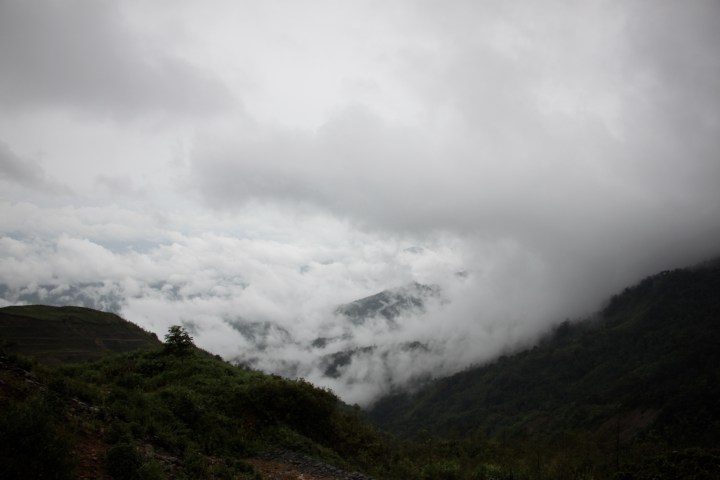
The path was muddy, and it wasn’t long before my boots and socks were soaked through. Also the poncho was kind of small, so it covered my bag alright but left me completely exposed; so now my windbreaker was taking the brunt of the rain, along with the khakis I’d bought in Gangtok. The button had fallen off them during the night and now I was just holding them up with my belt. And then my hair was drenched, dripping down onto my face, obscuring my vision. At first we were all talking, commenting on a weird branch here or there, but after a while we grew silent, just moving on ahead. We past poncho-clad climbers, their porters dragging along behind them, in flip-flops, muddy feet and ankles, heading back down. As we climbed, the snow line from the parallel mountains gained on us; I could tell we weren’t far off from entering it. This fog, or mist, was appearing, the trail becoming less clear; you couldn’t see very far ahead anymore, and there was an eerie silence that felt like it was overtaking things. I was in front, trudging on forward, two hours from Bamboo.

I don’t know when it hit me, necessarily, but it felt so ominous and critical. The feeling that this was wrong, and stupid. It was some gut instinct that had appeared, and now I couldn’t turn away from. The same gut instinct that’d told me everything: go back to India, live in Goa, go to Japan, take this train, stop here, all of it. I don’t know what that voice is, or where it comes from. It’s like some internal monologue we don’t control, one that tells us exactly what we must do. Like it’s got foresight into the current moment, and then also a vision into something far beyond. As if it’d told me to go back to India because it’d known I’d end up here, with the realization I now had: it’d been foolish, maybe all of it, but it hadn’t existed in a vacuum. There had been motivations, psychological issues to unpack, all that. It’s like the voice knew, and had led me down this path with some long game in mind. Maybe it’s what people call God, or Fate. Maybe they need that voice to have a name, to come from some external source – it’s not you, it’s something else. Something else is in control, and all you have to do is follow. I don’t have to know where it comes from. I won’t take credit for it; it doesn’t even seem rooted in logic or experience. It just is. So call it what you want.

Anyway, that’s what the voice said: this is wrong, and stupid. And I suppose – as is usually the case – you get to choose whether you want to ignore that voice or follow it. So here I was, walking along the trail, up into the fog, into the unknown, this feeling accumulating, more and more with each step. So I stopped walking. I looked up into the distance, and off to mountains. We were on the silent precipice of a different realm, a thick wall of haze to pass through, into the beyond. The rain was beating down, hard. I felt cold. It was only this, out ahead. I’d stopped.

The thing was, there were so many practical reasons to stop. People were missing, were potentially dead. There were great risks here, risks people had taken, documented risks throughout the years: all logic says don’t go on, you go on, tragedy befalls you. It’s basically the plot of every expedition movie. And furthermore, it wasn’t like I’d come out here with the goal of reaching ABC; I hadn’t even known it’d existed, hadn’t even planned on coming to Nepal. I couldn’t have had less of a stake in this thing. So the general consensus should have been: Stop, this is dangerous, you don’t even really want it. But it felt like the voice wasn’t interested in those reasons: it was answering to something larger, something enveloping me: the real reason I’d been pushing on, fighting reason, Henry: something internal that wouldn’t let it go, wouldn’t let it rest. And what was it? Some intense ego that I couldn’t survive? Or was it something deeper? That big internal void, that massive gaping hole that said: this will solve it, this will make you happy, this will be the end. Was that it? What was it? Up here, it didn’t seem to matter. It’d led me so far: across countries and continents, into seas, up mountains. And I was realizing I was exhausted. Fundamentally and purposefully exhausted. I was so very tired.

And so it felt disastrously important, then, that I make the change. That I learn to say: Okay. It’s enough. Not this one. To let something go – not to give up, maybe, but to accept that it’s our plot in life to decide what matters and what doesn’t, what is worth fighting for and what isn’t. It became so vividly clear that this wasn’t even about the mountain anymore: it was about me, always had been. That now I had to grow, to accept nature as bigger. To not push and push until there was nothing left of myself. To not walk off into the fog, at least not yet.

I turned around, and there was Henry. He was wearing his raincoat, navy blue, and then his massive pack with its red cover pulled over it. His hair was wet and curly, and flipping up in parabolas on the left side. His glasses, these thin circular frames, were completely fogged – it happened when his temperature rose and he began to sweat. He was dripping, standing a couple feet below me on the trail. He looked like something out of a wilderness horror film, like it was only a matter of time before there was a crack in his glasses and we all realized he’d been shot through the eye. I hated him in that moment. I loved him, but I also hated him. Because I knew what he wanted, what he represented – he’d said it himself. He was going on, but only because he’d realized I’d never stop. It was clear we were diverging, somewhere: something instinctual that led him towards rationality and logic, and led me towards whatever was beyond. I knew he was afraid, and I hated that. But he was right to be afraid. The only reason I wasn’t was because whatever was inside me was stronger than anything resembling sense. But I’d come as far as I could go this way. If the voice was doing anything, it was presenting me with an alternative. It was okay. To let it go. You’d survive letting it go. You’d be stronger for it. You’d be better for it. It was braver to lay down your arms sometimes. I could see that now. I’d been here before, and I hadn’t. But it was in my control to do that now. So I looked down at him, all fogged up and panting out here in the wild. And I laid it down.
 

Honey: Selected Journals from the Years Away
From Book V: With The Salarymen
6.3.17 to 12.3.17: Annapurna Conservation Area, Nepal (Part II)

Note: Please read Part I before continuing on with this section.


The following morning Henry and I took a 7AM bus to Pokhara. Yaz and her mom had booked a flight in advance and were meeting us there. The bus was a tourist bus, meaning it was specifically for foreigners traveling from Kathmandu to Pokhara – not like the one I’d taken from the border to Kathmandu. The tourist buses generally operated in a triangle, the third point being Chitwan National Park to the south. Everything else in Nepal was relatively unknown to travelers – as in Lonely Planet didn’t even bother covering it – but I was pretty confident that there weren’t any artisanal coffee shops out there.

So down the street from Alobar were dozens of buses lined up, waiting to take tourists to Pokhara or Chitwan, all indistinguishable from one another; the drivers took the massive backpacks, with their snaps and clips and drawstrings, and tossed them into the boot, motioning to climb aboard. The buses were full of white people all looking aimlessly out in of front of them; you couldn’t really think of anything but sheep. The whole thing made me pretty uncomfortable. Nothing even remotely close to a tourist bus existed in India. I asked Henry if it’d been like this in Vietnam, where he’d been before arriving in Nepal; he said yeah, it’d even been more touristy than this.

Henry’s real name was Henry; I’d been trying to call him Doc as like a fun nickname but it wasn’t really sticking. He was from New Zealand, and had only six months left of med school before he became a fully accredited doctor. He wanted to work in the Emergency Room because he said it’d always be exciting – which I suppose is true, but it might get really depressing, people coming in with broken arms and legs and gunshot wounds, and you having to constantly stitch them up and send them back out there. I asked Henry if there was much gun violence in New Zealand, and he said no, practically none. So I guess their ERs are different than ours, which I always picture just being full of people with bullets in them. Henry said there was this rule in New Zealand where the police had to keep their guns in their cars, which sounded like a really solid rule.

The roads in Nepal were not of good quality. The bus lurched and dragged and waited long periods of time for other buses to pass along the narrow roads. The route was only 200km, but it was taking a long time because of the conditions; I was mostly nervous because we still had to get our permits before setting off the next morning, and the office closed at 5PM. So Henry and I talked about wealth inequality and health care and capitalism and truth in art – stuff that gets me real worked up – and by the journey’s end my throat was starting to hurt from all my pontificating. I could tell Henry was a good guy, especially when he said he liked jazz but didn’t act like a total dick about it. Anyway, we arrived in Pokhara at around 4:30PM and hustled over to the permit office to purchase a TIMS (Trekkers’ Information Management System) permit and an ACAP (Annapurna Conservation Area Project) permit for Rs. 2000 each – so it cost like $40 USD in permits just to enter the mountain range itself. The office was giving out free passport photos, though, which was oddly nice of them.

Henry and I then began walking north towards the hostel we’d booked, through an area of Pokhara known as Lakeside on account of it being right beside the lake. Lakeside was one long street populated by a mixture of classy restaurants and cheap bars; like Thamel, it was the base for those either heading to or coming from Annapurna. The walk was long and we were carrying all our shit, and Henry had to go to the bathroom real bad but was being a good sport about it – I figured it was a good warm-up for the actual trekking we’d be doing the following day. We turned off the main strip, down an alleyway lined by disfigured concrete walls; the walls were topped with broken glass to I guess keep birds from resting there. A group of local kids were climbing the walls and jumping back down onto the street; their proximity to the broken glass was giving me a lot of anxiety.

We were staying at a place called Pushkar Guest House; the rooms were tiny, packed with seven beds – three bunks and then a single against the back wall – and since everyone was trekking pretty much all spare space was covered in packs and gear and layers and guidebooks and maps. Immediately I began sorting what to take and what to leave behind: I wasn’t bringing my laptop, journals, any of my books – really just a few pairs of clothing, boots, the jacket and sleeping bag I’d rented on the main road for Rs. 100/day, and then the hash I’d gotten from the South Africans and Rapden’s homegrown weed. All non-essentials I stored down in Pushkar’s interior, the living room filled with tagged bags – literally no part of this was ideal, but I didn’t have much of a choice. I still wasn’t entirely sure I even wanted to do the trek, but I figured at this point I didn’t have a choice with that either. Anyway, so Henry and I walked back into town and ate large pizzas like it was our Last Meal or some shit; and then we both took $300 USD out from the ATM and went to bed early. I had a crummy night’s sleep.

The sun wasn’t up the next morning when Yaz and her mom arrived in a taxi that was to take us to the trek’s starting point: Nayapul, 1070m above sea level and 40km from Pokhara. So I was scrunched in the backseat with Yaz and her mom as we set off; Yaz’s mom was small, with shortly cropped brown hair, dark like Yaz but with a fuller face. She seemed pretty motherly almost immediately; I’d been sort of banking on that, having a mom and then a doctor (Henry) around in case anything happened up there. We mostly talked about where all we’d been, which is generally a safe conversational mode to fall into amongst travelers.

After a half-hour, we pulled over so the driver could have a cigarette and the four of us could get a glimpse of the mountain range: you could see them beyond the green expanse: a wavelike formation of snow-capped peaks: Annapurna I, Annapurna IV, Annapurna South, and then Machhapuchhre. The driver said: The visibility is good. Everyone was always talking about visibility. I took some photographs. Then we got back in the car and continued on.

Nayapul was crowded with trekkers, and then several restaurants and shops selling last-minute goods. Everybody was taking off their shoes and socks and putting on other pairs of shoes and socks. We joined the procession across a bridge covered in dirty prayer flags and presented our papers at the checkpoint, getting our permits stamped. Immediately I ate the only three oranges I’d brought along. So we followed a large group of Asians onto the trail; they were decked out in form-fitting mountain wear and poles and snow goggles. They were stopping to take photos of nearly everything: signs, paths, rocks, rivers, each other. It was pretty damn annoying. I was thinking that if this was the way the whole thing was gonna be we might as well just forget it. But we got around them quickly enough, and once the procession spread out it was just the four of us, heading up the rocky track.

It was hot, and Henry was in shorts and a t-shirt and hiking boots with his massive black pack, working his way up the hill; he’d been slower than me the day before, on the way from the bus to the hostel, but I think that was because he’d had to go to the bathroom and was trying to hold it so bad. I was still in my tennis shoes; the boots I’d rented at Alobar were slightly small, and I was afraid I’d blister if I wore them too much. All around us were fields, sectioned off, sitting in the makeshift canyon, the sun beating down in a sandy brown. The hills rose in this uniform green, the kind where you can’t decipher what the ground actually looks like, if this path was once like that before it’d been carved out for us. When I was a kid, on long drives through forgotten terrains, I always wanted to go lunging off into that uncharted earth, clawing my way up – this sense of harsh and steely reality, up there all alone. I still kind of feel that way.

We stopped for lunch in Banjhgara; a plate of momos cost Rs. 350, which was quite high. But the way it works on the mountain is that food is ridiculously expensive and lodging costs nothing. The reason for this is that it’s quite difficult to get provisions up the mountain, because whoever’s bringing it up has to do the damn trek every time. So it stands to reason that it’d be smart to bring food along with you, like power bars or some shit – but I never think of that because I’m an idiot. It also takes a very long time to prepare the food, because the guy doesn’t have plates of momos waiting around for you – he only starts making the shit when you show up. So after we ate we continued up the trail, me feeling really sweaty and uncomfortable with all these random pieces of luggage hanging off me – my camera, water bottle, collapsible Patagonia jacket. Henry was definitely the quickest, Yaz’s mom definitely the slowest – but she had this Tortoise and the Hare mentality where she’d just set a pace and keep going, even when the rest of us stopped for a break. I had to admire her for it, like it was somehow related to maturity and wisdom that she was using such a method.

Eventually we reached Tikhedhungga (1540m), where the itinerary Yaz had gotten from one of her dad’s friends said we were supposed to stop for the night – but per usual people were feeling pretty good and were keen to soldier on. I was an advocate for spending the night and heading up to Ghorepani tomorrow – that going too far on the first day would be detrimental down the road.

I was mostly thinking about Joelle, and her warnings about altitude sickness. I’d encountered it before: back when we’d fly from Pune to Ladakh there’d be a change in elevation by nearly 3000m – splitting headaches and fatigue would knock you out cold for 24 hours up there. It wasn’t much of a concern when you were traveling by foot – you’d acclimate as you climbed – but you had to keep it in mind. Because basically what’d happened to Jo was that she’d rocketed up the mountain in two days and gotten so sick that they’d had to get a helicopter to airlift her out. She’d been fine after some time in the hospital, but it was some serious shit. And more importantly, helicopters weren’t cheap and I didn’t have any form of traveler’s insurance. When I told people that last part they usually looked at me like I’d made some sort of grave and irreconcilable error.

Anyway, so I was always for taking it slow, and the group generally agreed, even though it meant watching several trekkers – including the Asian photographers – trudge on past towards Ulleri, which was sort of a gut punch to the old ego. The only other concern was that those going ahead would reach Ghorepani first, meaning less rooms available when we did arrive after them tomorrow evening; the guy at the lodge in Tikhedhungga said they’d certainly have enough rooms there, but obviously he had a vested interest in the whole thing. Regardless, we decided to stop for the night and just leave early the next morning to try and catch those who’d passed us.

Tikhedhungga was a small village of two-story wooden guesthouses, all painted royal blue and offering hot showers, electricity, western toilets, etc. Since there wasn’t any discernable difference between them, it was sort of up to intuition – so we stopped at the first one and I asked the owner to see the rooms. He led me up this iron staircase and unlocked one of the doors. The room was a small cube made of balsawood slats, and then four latched windows overlooking the canyon; there were two twin beds and a single light bulb hanging from a wire stapled to the ceiling. I was like: Yeah, this is fine. Then I said: So maybe you let us stay here complimentary, and we take food from you? He was like: Yeah, fine. He knew the score. So I followed him back downstairs and nodded to the group.

The sun was setting by 5PM, and the air grew cold; the lodge’s owner brought small candles into the restaurants as we all bundled up for dinner. Yaz started talking about what she’d done back home before starting to travel: she’d worked for the Police Department in the Office of Domestic Abuse. Her job had been to get ahold of the victim during the 24 hours in which the offender was jailed before charges had to be pressed. So basically Yaz had to track these women down and talk with them, provide them with as much support as possible, try to usher them towards breaking the cycle of abuse, etc. – it sounded like a really harrowing job, especially for someone so young. And then right before she left, they’d consolidated her department, which dealt specifically with the victims, in with the department that also handled the offenders; so obviously resources had been stretched rather thin, often favoring the offenders and leaving the victims in the lurch, especially when the detectives didn’t reach a conviction and the offender returned home royally pissed about the whole thing. And so Yaz had left, unwilling to be complicit in something she saw as so morally impermissible. We sat drinking our tea post-dinner as the candles receded into themselves, a circle of vision slowly collapsing, until we headed up to bed at 8PM.

Back in our balsawood room, I folded a photocopy of my passport in half, breaking up some of Rapden’s weed and the South African hash; I poured it down the paper’s crease into a bowl I’d purchased for $4 USD back in Kathmandu. I was realizing I hadn’t packed a bowl since college, maybe even since freshman year, back when I’d do my handiwork in the dim light of my desk lamp while Cory lay in bed. Then I’d text Joe and Mitch, and they’d come by as I finished; I’d put the bowl in my North Face pocket, my thumb over to the top; we’d take the back stairwell out of Trever, follow the dirt path down to the woods. And then the three of us would stand there as I lit up, the small flame of some cheap lighter throwing a warm glow onto our faces for a moment; we’d look out into the nothing before us, on the precipice of this shadowy decline, listen to the rushing of the Fox River, night after night, as the seasons darkened.

Henry and I lit up, and the stuff was smooth – no burn at all. Then we revealed our ages to each other, which people are often hesitant to do. Henry was 23, and I was 24 – so we both relaxed a bit. Henry had thought I was older, mostly because of the beard and because I’d say stuff like: “Back in University,” which made it sound like that was a lot further back than it actually was; we both had a good laugh at that. So we turned off the hanging light and lay down to bed. Since we were both high, one of us said that we needed to start sending people into space again, and the other agreed adamantly. Henry said we probably had the technology to send a man to Mars, but probably wouldn’t be able to bring him back. I said it’d be a pretty good headline: NASA Sends Man to Die in Space – and we both laughed for a long time at that. Then we had the obligatory conversation about how even out here the government, and Google and Facebook probably, still knew where we were – and were most likely selling our information to the highest bidder for advertising purposes – and out the window was this deep darkness of isolation, away from roads and life and all things known to us, here in the mountains. We were only going higher. We put our headphones on and fell asleep.

~~~

We awoke the next morning at 6:15AM, and after breakfast shoved off across a steel bridge that wound its cables over the canyon. The track led uphill, a steep and rocky staircase crisscrossing the mountainside; we’d been warned about this, which was partially why we’d saved it for the morning as opposed to pushing on the previous day. It was a wall of earth, practically vertical; the steps were crumbling and disorderly; it took two hours of traversing until we could finally see the wide berth of it all descending below us. Climbing alongside us was a group of schoolchildren in red sweaters, their plastic Minion backpacks dirty with dust. They arrived beside us effortlessly; Yaz’s mom – who we’d taken to just calling Mom, for practical and familial purposes – stopped to give them each a Jelly Baby, this sugar-covered gummy from the UK. There was a horn sounding off in the distance, and one of the little girls started crying. It was a funeral procession, on its way to the burning pyre. A group of men came up behind us, carrying the body wrapped in an orange shawl; we stopped and watched as they moved the corpse on a stretcher made from tree branches. After they’d passed, Mom started talking to the children – she spoke a bit of Hindi, as did they. They told Mom that they went up this hill daily to get to school. They tumbled on ahead of us; we stood there with our packs and poles, watching them go.

It was the next leg of the journey, though, up to Ghorepani, that was the real bitch for me. Because now there wasn’t even much of a defined path, just rock formations resembling staircases, leading up and down through this ominous forest that appeared to be slowly decaying and generally didn’t want us there. Henry said it reminded him of New Zealand – and it did look like something from Lord of the Rings, like a part where Frodo and Sam are very far away indeed from the Shire or whatever and shit is getting very real. Today Yaz was in front, Henry and I keeping up behind her, and Mom coming along with her incredible pace in the rear. The thing I was realizing about trekking was that oftentimes there was never a full-on leader: it was whoever felt best that day, was willing to take it on. Originally I’d been somewhat nervous, this competitive nature rising up in me; but after 24 hours I started to feel as though I had no reason to compare myself to these people – that we were a unit, a team, more than anything else – and so that faded away. We reached this spout, a piece of bamboo cut in half protruding from the moss-covered rocks, water spilling out of it; Henry and I filled our bottles, wet our faces with the freezing water.

We stopped for lunch at this large building that looked like an abandoned saloon. Everyone was sitting outside at unpolished wooden tables, the sun beating down. There were white kids running around; they’d chase each other for a while and then go sidle up to their parents who drinking tea in massive outerwear. I couldn’t imagine doing something like this as a kid, but then again I guess they’ve got the energy and also they don’t know what’s going on anyway. So we all sat in the sun and for some reason discussed drugs, with Henry and I fessing up to smoking the previous night and mostly likely smoking again that night. At first I felt sort of weird admitting all of this in front of Mom, but she seemed genuinely interested and receptive to the conversation. We’d ordered spring rolls – which turned out to be these big greasy patties stuffed with vegetables – but it was taking so long to prepare that we ended up sitting there for an hour and a half. It was becoming clear that these involuntarily long lunches were always going to mess with our projected daily distance.

It was overcast by the time we reached Ghorepani (2860m), nearly 5PM. The village appeared empty, this wide plane of Swiss chalet-looking lodges surrounded by smoky green hills. Ghorepani serves as something of a base for those trekking up to Poon Hill, an hour-long jaunt directly north that offers a solid view of the Annapurna range; many trekkers just head back from there, or circle around to Chomrong and then descend. I felt a bit foolish for thinking there wouldn’t be room for us; the place was a ghost town. So I arbitrarily chose this one faux-chalet, See You Lodge, and conversed with a sleepy-eyed man in the restaurant. He led me upstairs to the balsawood rooms and I proposed the Complimentary Deal; he said fine, but only if I kept quiet about it. So I was like: Sure. I went back downstairs and nodded to the group.

So that night we were all sitting in the restaurant lit by candles once again. It was a large square room with a perimeter of plate glass windows blacked out by the night; and then an old timey iron furnace in the room’s center with a thick black pipe running up through the ceiling. On the back wall was a framed photograph of a wedding party. The picture seemed oddly airbrushed and enhanced; it looked as though the bride and groom had the exact same face, as if someone had created a portrait in which they’d married themselves. I couldn’t tell if this was a side effect of altitude sickness or if I was losing my mind – or if some Nepalese man/woman had actually consummated a more perfect union. The restaurant was shared by a large group of the Asian photographers who were all sitting around the furnace rubbing their hands together; and then this guy from Holland in Crocs and skintight leggings who was bragging about how he’d made it up in one day and seemed to expect some sort of medal for it.

And so after we’d eaten and were having a late-night ginger honey lemon tea, Yaz started talking about her boyfriend. All I knew about Yaz’s dude was that they had this vague plan to move to Canada together. This guy’s name was Dan, and she’d met him while working at a bar in New Zealand, trying to raise funds for future travels; Dan kept coming into the bar and telling Yaz she was the most beautiful girl he’d ever seen and asking her out until Yaz finally agreed to go. Dan was from Wales, but was working in New Zealand for an unspecified amount of time as a fencer. So then basically they’d spent seven weeks together having the time of their respective lives, with the understanding that it was going to end with Yaz left New Zealand; but it was going so swimmingly that Dan wanted to keep on after that, and I guess was so persuasive and Good With Words that Yaz said: Yeah, alright. Except also concurrently Yaz had met this guy Nico from Argentina while at a hostel in Queenstown and was about to travel through Indonesia with him, the attraction between them always being very much present but only coming to fruition during their mutual sojourn. And so meanwhile Dan becomes something of a jealous prick (maybe with reason, admittedly) and is really pressuring Yaz to move to Canada with him and start a life. But then also Dan is being somewhat emotionally abusive now, oscillating between shitting on Yaz relentlessly and also professing his deep and unadulterated love for her in some classic psychologically-manipulative relationship shit. Sounds like there was something of a narrative climax when Dan flew to the Philippines to meet Yaz and Nico, and the three of them actually had dinner together – along with Mom and Yaz’s dad, who clearly chose in inopportune time to visit but were keeping mum about the whole thing and letting Yaz figure it out on her own. And so shortly thereafter Nico leaves and Dan and Yaz continue on together in Thailand, except now Dan is being even more emotionally abusive, in person now, which has Yaz calling home – and actually calling Nico up as well – crying about how terrible and manipulative he is, until she’s finally able to escape to Nepal. Like a week back. Anyway, the Current Situation was that Yaz couldn’t really get the break-up to stick because Dan was so Good With Words and Manipulative – and was honestly so insane that he was filling out Yaz’s Canadian immigration papers on her behalf, without telling her. At which point the advice from Henry and I had to obviously be: Get rid of this guy quick.

It was strange, discussing all of this while so isolated, away from sound and light. I suppose it made it easier, for all of us, here in the mountains, to look at ourselves, clearly, to understand our trajectories and ourselves. The irony wasn’t lost on Yaz that she’d worked so closely with victims of domestic abuse and now found herself in this situation. The irony of my own endless situations wasn’t lost on me either. It all felt categorically cyclical. And out here, with such space and time, you could feel a silent hopelessness to it – as if you’d paused the action but couldn’t affect the outcome. Like floating above yourself. I suppose we technically were, at this height.

And so we went upstairs to bed. Henry and I smoked up, and talked about what’s going on inside the minds of cats and dogs. One of the Asian photographers banged on our door and asked us to be quiet. We lay there petrified in the darkness until we eventually fell into sleep.

~~~

The next morning we woke up early to go watch the sunrise on Poon Hill (3193m), along with pretty much every other person staying in Ghorepani. The bizarrely named Poon Hill offered views of Annapurna I, IV, South, and then Machhapuchhre. Travelers knew Machhapuchhre by its English translation, Fishtail Mountain, on account of it looking like a fishtail; climbers weren’t actually allowed to summit the mountain since it was considered a sacred site and purportedly Shiva’s home. Anyway, Henry and I waited outside in the dark with the Holland guy while Mom and Yaz got ready. Both Henry and the Holland guy had headlamps on. I was relatively anxious to get going, because I knew the Asian photographers would be coming along shortly, with their poles and cameras and selfie sticks, and it’d be a real pain in the ass trying to get around them on the trail. Up above you could see new magnitudes of stars, but it was relatively hard to appreciate them because it was so damn cold. Shortly thereafter Mom and Yaz came out, and we set off.

Poon Hill was not a fun climb. There was no warm-up, just an immediate uphill zigzag thru pure black, punctuated only by various headlamps and flashlights. You couldn’t really rest, at least not for the first half, because the trail was so thin that if you stopped you’d clog up the procession following closely behind you. I was feeling a bit of a headache coming on – Poon Hill was 300m higher than Ghorepani – but I kept on. We reached a plateau with a wooden ticket booth; everyone paid Rs. 50 and continued up the wider steps. Henry and I paused beside a satellite tower on the next landing, waiting for the girls. An Indian girl and a Nepalese man, presumably her guide, reached the landing and the girl sat down on the steps. “It’s fine,” she was saying, “I can see the sunrise from here. Beautiful view.” The guy was saying: “No, no, we’re close – it’s five minutes more.” The guy sat down beside her, and she put her hand on his shoulder. He reached up and rubbed her hand. “Here is fine,” she kept saying; and he kept saying it was only a bit further; and then she vomited all over the ground and the guy said: “Oh shit.” The girl kept vomiting, repeatedly, onto the steps before her. A white lady passed her and said, absentmindedly: “I think there’s a trashcan up there.” Henry and I moved on.

On the next landing we sat beside two girls who were pretty cute; I said: “It seems like there’s always another hill.” They were like: Yeah. I was short of breath, flushed in the face. When they set off we followed; they seemed to be setting a good pace. It seemed almost imperative to focus on one of the girls’ snow-panted ass before me, not the physical pain. When we reached the top the sun was just starting to light up the horizon. It was really fucking cold. Out in the distance, to the northeast, you could see the four peaks, the general range; the sun was coming up in the east. People were wandering around the pavilion, taking photos, talking casually – loads of people, people I hadn’t seen at the lodges or on the trail, all congregated here. The view looked like a postcard. Mom and Yaz arrived, and Mom bought us all coffee; we took some photos, and then went back down.

The day consisted mostly of traversing the ridge of a high hill, on and on, like the spine of some massive animal we were attempting to tightrope across; and then downhill, into the forest – we took it running, jumping between rocks. By lunchtime we’d reached this small village; thunder and lightning started up, and then it began to rain, or hail, or snow, or some combination. An old woman in a headscarf appeared in the doorway of a shack and waved us over; so we ran to her and took shelter inside. She began lighting the old timey furnace. I had literally no rain gear: my reversible Patagonia was maybe waterproof, but otherwise I was way out of my element. We’d been trying to make it to Ghurnung that day, but now it didn’t seem like we’d make it past Tadapani. Out back a girl was trying to herd donkeys into the barn, but they weren’t listening and you could tell she was really frustrated. We all stood at the window watching, cringing as she slapped them with a thin long stick and screamed.

In from the rain/snow/hail came these three German girls, panting. We all stared at each other. The Babushka Lady got the furnace going, and so everyone crowded around to warm up; Yaz started waving her butt back and forth against it. Two of the Germans, sisters, had been working at an NGO their uncle ran in some village, and had decided to trek afterwards; I was positive they were the cute girls Henry and I had seen that morning, one of whose snow-panted asses had led me up Poon Hill. The third German was traveling solo, and started listing off her countries like a grocery list; I’d seen her early on the Spine with her poles – she’d looked angry. It seemed as though the weather wasn’t letting up, so we all ordered lunch and tried to decide what to do. It felt, for the first time, as though things were as they actually were: that we were stuck in some abandoned cabin, in the middle of nowhere, with only a furnace to warm us, the modern world having no chance of helping us even if they’d wanted to. I felt, for the first time, the immediate realization that this was actually a dangerous undertaking – that we were closer to death than I’d understood, that any semblance of a safety net was now non-existent. That you could slip and fall and bust your head open and die and no one would even know. It was theoretically a lot more terrifying than it actually was; in reality, it didn’t change much.

We eventually set off, thinking it wasn’t going to get any better. The Germans came with us. We trekked on down along a river, as the rain/snow/hail became proper rain, turning the accumulated snow into mush and making the rhododendrons hang heavily on their branches. Monkeys swung between the thin trees: real ones, not the fucked-up ones from the Monkey Temple. The rain was coming on so hard now that my hair was drenched; my bag had to be too. The trail diverged from the river and started on an incline; I peed something hot, yellow-orange, behind a bush. Henry and I discussed the Germans. I called the older blonde, Charlotte; he said he was fine with the younger brunette, Henrietta.

Uphill got rough. The place felt like a jungle, like it was sagging, weighing down on us, trying to crush us. Up ahead were some old folks, with their guides and porters, decked out in neon gear, breathing heavily, this look of pure despair clouding their faces. We all took cover under a large rock nestled into cliffside; I went up ahead, trying to see how much further we had, looking back down at everyone. They all appeared ragged, spent, desolate, fighting nature, currently inside whatever this was. I felt some sort of loose power in my hands, a reckless mania, a sense of abandonment I couldn’t reconcile. I called down: “There’s a McDonald’s!” Everyone laughed. “And they made too many fries, so they’re giving them away free!” People laughed less at that.

Eventually we ascended up to Tadapani and the Angry German broke off for the night while the rest of us trekked on to Chuile (2245m). Now the path led downhill, opening up into fields of green and ramshackle farms, like something out of the Scottish countryside, surrounded by massive darkening cliffs. We passed through a wooden gate and came upon the one lodge in Chuile: a motel-style building with two floors of doors and windows, and then an adjacent restaurant; the compound sat on a large swath of perfectly green grass, as if it’d been leveled, before tumbling off into the wide sprawl below. There was a singular horse with a bell around its neck that clanged as it shuffled around, and then four dogs chasing each other and barking. Everything felt strange to me, as if the place had been plopped down here randomly, already built and existing – there was no village, nothing surrounding it except empty farms. So I went into the restaurant and found a group of Nepalese men playing cards and drinking; I said we needed three rooms – the German sisters had fallen behind, but I wanted to be sure they had something for the night. One of the men lifted himself from the table and showed me the accommodations while the others stood on the grass staring at the horse. So I tried my Complimentary Deal and the guy was like: Yeah. It seemed like maybe he didn’t understand, so I explained it three times slowly, touching his arm and all to emphasize that we were making a Deal – and he was still like: Yeah, whatever. He went back inside to his card game.

So after we’d put our shit in the rooms we went into the restaurant to have a tea. Inside there was this dark-skinned guy with glasses drumming loudly on the tabletop with his hands and looking around shiftily to see if anyone was paying attention. He heard Henry talking, and yelled across the room that he’d lived in Christchurch for four years. It was nice, because after we’d parted ways with the Holland guy there’d been a vacant position re: someone to hate – and this dude seemed to be sliding in quite easily. Through the windows I saw the German sisters trudging across the field – so I went outside and told them I’d sorted out the rooms, figuring they had to be impressed by my negotiating skills. When I got back inside Yaz rolled her eyes theatrically. I said: “You’re just jealous.” The drumming guy and his buddy, this amorphously good-looking European dude, went outside for an opportunely timed cigarette. Turned out they’d stayed at the same lodge as the German girls the night before and had played cards. Henry said: “That drumming guy is working on your girl.” I said: “I can’t be bothered.” Yaz said: “Yeah right.” I said: “I can’t just flirt with everything that roves into my field of vision.” Yaz said: “You can try.” Mom was smiling.

What ended up happening, though, was that I was sitting there writing shortly thereafter, and hadn’t made it but a paragraph in when Charlotte sidled up next to me. Outside Drum Man was doing some faux-yoga poses with his vague friend to no avail. She asked what I was doing, so I told her. She was a nearly graduated psychology student, training to be a therapist; I didn’t feel like it was necessarily the time to announce: “Hey! I’ve seen many therapists!” so I just asked if psychiatry was stigmatized in Germany, which sounded like a pretty intellectual question. She said it was about the same as in America. She was 25 and had big beautiful eyes and the sort of defined cheekbones that Vincent Cassel is known for, and then this amazing long blonde hair that seemed to be naturally braided by some supernatural force. Soon her sister came over and slid in across from us where Henry was reading George Saunders and started talking with him – and so now there were these two conversations going, like kismet, with Henry and I occasionally snatching glances at each other like: Can you believe this shit? Yaz’s eyes were rolling so far back into her skull that I was afraid they were gonna get stuck there and we’d have to airlift her out.

And so the sun came down and we all ate dinner, the Germans and Mom and Yaz and Henry and I, here in this ominous chateau in the Himalayas. Drum Man was sat in another booth with his companions; it turned out he was part of a tour group, replete with guides and porters, also heading up to ABC. He’d brought along a 1L water bottle full of whiskey, and kept trying to get others to drink with him but no one was really biting. I assumed it was quite difficult for him to see the Germans with us and not drinking whiskey with him – which gave me this warm feeling that I assume good whiskey attempts to give you. It turned out Henrietta had lived in New Zealand for a while as well, and her and Henry were intimately discussing this Walmart-esque store there called the Warehouse. Yaz and I were yelling animatedly about how I’d never thrown up except from drinking and she hadn’t thrown up since she was two, except from food poisoning this past New Year’s in Thailand – which I said meant she could no longer claim to live a non-self-induced vomit-free lifestyle. She completely disagreed. Henrietta said you weren’t supposed to brush your teeth after you threw up – and we asked Henry’s opinion, as a doctor, and he said: Well, vomit is an acid and toothpaste is a base, so it figured that they’d cancel each other out; and then Henrietta said her boyfriend was a dentist and he’d told her that. So that really threw us all through a loop, Henrietta having a boyfriend, and I felt sort of bad for Henry but I suppose that’s the way the cookie crumbles.

Charlotte and I ended up over by the furnace alone, while Drum Man tried to get a card game going and Henry went back to his book and Yaz and Mom went to bed. We were sitting very close. The heat was drifting off the furnace, this small halo of warmth we’d stepped into. Charlotte said she’d worked in various hospitals during her studies, interacting with people experiencing psychosis – and how after spending so much time with them she’d sometimes lay awake at night wondering if she herself was psychotic and didn’t know it, the way her patients didn’t either. There was something very German and serious about her use of the word “psychosis” that took away some of the ambiguities we circled around back home. I was surprised by her candor with the thing, drawn in by it. I could feel the rough edges of whatever empirical attraction I’d felt towards her being sanded away, towards something – for lack of a better word – deeper. She said I had very beautiful, very intense eyes – eyes that intimidated her, eyes full of life. I believed her. She said I had a habit of blinking with one eye at a time, like a wave across my face – something Henry had mentioned too that I guess I’d picked up somewhere along the trail. She asked what my friends and family thought about all this, about me being so far out here, all alone, not telling anyone anything. I said that it was just something I had to do, and that they understood – and that even if they didn’t it wouldn’t change anything. She said she was impressed that I carried everything on my back for so long, that I didn’t wear any winter clothes up here.

I realized, somewhat abstractly, how she must view me: wild, untethered, perhaps mad. The part that remained unclear, that perhaps she was trying to figure out – that perhaps I was trying to figure out as well – was whether I was walking the string of the thing, or if I’d fallen off into the abyss. It was like she saw it, and I saw it, but we both didn’t know.

So we walked outside, presumably to bed. My stomach was tightening, convulsing, and there was that weird acidic taste sprouting up in my mouth; I was realizing I hadn’t kissed someone for the first time, sober, since maybe my first year of college. The dogs were walking around, and we realized that they had socks in their mouths; “I hope they’re not mine,” she said, going to fetch them. The horse was nowhere in sight. It had grown so cold: I was freezing, shivering uncontrollably. My mind was running through all sorts of various scenarios: I am cold, snuggle with me; come to my room for a bit; come here. I just wanted her in that vague way you want something, anything, but you don’t really know yourself. You’re just some rough shell of what you assumed you’d be. But instead she’s just collecting socks from the mouths of dogs, and I’m standing there watching her in the cold mountains.

Eventually we said goodnight and I went into the room, where Henry was curled up in his sleeping bag. I took my contacts out and went to the bathroom down the hall. Drum Guy and his amorphous friend were running around the field, giggling, lighting something with their cell phones. I washed my face; the water was cold. I headed back towards the room, where I could see something unclear moving in the distance; I went towards it, blind, foggy, trying to find our door, my arms outstretched; I heard a voice: “Trying to find your room?”

It was her. “I took my contacts out, I can’t see anything,” I said. We were standing before each other. “I’m wearing my glasses now,” she said. “See?” Her face appeared out of the darkness, suddenly so close. I realized I didn’t even know what she looked like, couldn’t conjure an image. I didn’t even know this woman. “Help me get back?” I said. She took me by the arm and led me. We stopped outside the door. I said thank you. She said you’re welcome. Our arms unclasped, tracing out to our hands, holding on softly for a moment, looking at each other, her just this fuzzy image – I, I whatever I am. I don’t know what it was. Why any of it mattered. There was no ground beneath our feet anyway. We lingered, her fingertips grasped before me; then there was a click, and she slipped. Her hand fell from mine. And then she was gone, off into the night.

Honey: Selected Journals from the Years Away
From Book V: With The Salarymen
2.3.17 to 4.3.17: Kathmandu, Nepal (Part I)


Kathmandu was dusty, and had lots of white people walking around. I don’t believe these two features were related. There were more foreigners than in India; maybe because it’s easier to get a Nepalese visa, or maybe because India is so big that the foreigners are all spread out. Part of the reason for this new demographic was that I’d chosen to stay in Thamel, the area Lonely Planet referred to as the “backpackers ghetto,” which is one of those terms I can’t tell whether I’m offended by or not. So Thamel was teeming with travelers, most of whom were either coming from or heading off to trek in the Himalayas; the slim streets were lined with chic restaurants, souvenir stores, gear shops – pretty much everything was off-brand imitation wear. And then guys in polyester zip-ups sidling up beside you, mumbling about weed, hash, mushrooms; and then coffee shops with leather couches and European outlets and pour-over and wi-fi and white kids running around like they weren’t in Nepal right now.

The only thing that felt remotely authentic, then, was the dust: swirling up in the wake of cars, carried through the streets via an incongruous wind, leaving a fine layer of grey covering all surfaces. You’d wipe your face with a napkin and it’d come back caked with dirt. I’d be pouring it out of my army surplus bag by day’s end, my notebooks looking all abandoned. It was like, for all the effort to westernize the place for modern trekkers, there were still some things you couldn’t transform.

The main reason I’d come to Nepal was kind of stupid; it was because I’d seen this movie Doctor Strange a few months back. In the film, Doctor Strange gets his precious doctor hands broken in a real bad car accident, and so he goes to Kathmandu in search of some mythical cure for his terrible nerve damage. So in the movie they show this sweeping view over the homogeneous city, like they always do, and then they show Steven Strange wandering around these dirt roads looking all harried and curious. Eventually he comes to a dark alley and these four Nepalese guys start beating the shit out of him. This is the sort of thing that never really gets any backlash but is pretty terrible. Like the dude’s been in Kathmandu for five minutes and already he’s getting robbed. What kind of message does that send about the place? I mean it’s clearly a plot device – so that his wizard friends can rescue him or whatever – but still, it shows no respect for the country. So after I saw that, I realized Nepal wasn’t very far away and I could actually go have a look for myself, and prove that dumb movie wrong for trying to pull that shit.

The day after I arrived I walked up to the Monkey Temple, which was west of Thamel atop a large hill overlooking the city; to get there you went through the local parts of Kathmandu, past roadwork sites and general stores – and then near-empty storage lockers with endless prayer beads hanging from wall hooks, the merchant sitting cross-legged on the concrete floor. Over a putrid river congested with trash, people sitting on loose lumber beside their tin shacks.

The temple was actually called Swayambhunath, one of the most important Buddhist pilgrimage sites – but the foreigners had taken to calling it the Monkey Temple, on account of it being overrun by diseased-looking monkeys. To reach the top you had to ascend this huge staircase, and then pay Rs. 200; most tourists took a taxi or private bus around to the back entrance. The stupa itself was a large white mound with a gold spike on top, and then four sets of Egyptian-looking eyes painted on, facing each direction. This stuff gets sort of confusing even for someone with a basic understanding of Eastern religions – because there was a bevy of Hindu iconography around too, and then lots of Indians praying. This in itself isn’t that surprising, considering – and I’m really, really simplifying this here for us laymen – Buddhism purportedly sprung from Hinduism itself (Buddha originally being an Indian prince and all – but this is really an unnecessary, if interesting, digression). But it’d be like seeing a Star of David in a church, and everyone being okay with that – which is pretty cool when you think about it. Anyway, so there were some people praying, and then a lot of white people taking pictures of those people praying. To the east you could see all of Kathmandu, a wide and dense block of colorful compact buildings – the kind of rooftop setting you could imagine Jason Bourne being chased across. Around the perimeter were vendors selling maps and trinkets, prayer flags and little brass pieces: stuff I was deeming junk, which I felt sort of bad about since it maybe had religious significance, even if it was being sold to tourists at inflated prices. They were also selling these glittering knives with intricate sheaths, and I was really curious i.e. who was buying these things and transporting them home. Anyway, I didn’t stick around long, there not being much to see except the view and then this kid chasing off monkeys and pushing around a stray office chair that was up there for some reason. It was only 2PM, and Lonely Planet said the sunset was quite beautiful; so I figured I’d check out the nearby Natural History Museum and kill some time.

Lonely Planet had the museum listed in their Quirky Kathmandu section, which basically meant: Hey, wanna see some shit? Which: Yeah, I did. So I walked down the back road as the cumbersome private buses wheeled their way up the turns, and came upon the rusting iron fence of the abandoned-looking museum compound. The grounds were overgrown and dead-looking; the Natural History Museum was a one-story rectangular building with a single plastic chair at the entrance. On the lawn were a couple dozen school kids in red blazers standing in a haphazard line; the teachers, also in blazers, kept trying to get the kids to perfect the line with little success. Teachers did the same thing when I was a kid; they’d spend so much time trying to get us in a perfect line instead of just teaching us. Like you’d be standing in some line for a half-hour and you wouldn’t even be going anywhere. I’m pretty sure it’s just a tactic to waste time. Anyway, I went to the entrance and paid an old lady Rs. 50 to get in.

The museum was straight up deserted. I could tell almost immediately that it was a pretty depressing place. It was just a big room with a ton of dead animals in it. So it was pretty clear that the place was less “quirky” and more “underfunded,” and that Lonely Planet taking potshots at a struggling Nepalese museum was kind of a dick move. The animals were not well preserved. They seemed to be decomposing in real time, with certain limbs hanging off, the glue holding it all together now peeling. They had this big alligator with a tail that looked as if it was just a bunch of brown strings tied together. The weirdest part was that all the eyes of the animals were offset, as in one often higher than the other, which made it look like their faces were melting; and then some of the animals had completely collapsed, just a pile of body parts and paper nameplates. They had a lot of glass jars holding baby animals, floating in a clear liquid. It was altogether very creepy. Particularly the massive snakes in these elongated topless tanks, their mouths wide open; it wasn’t entirely clear whether they were dead or just not moving, waiting to attack. The whole thing was really spooking me, which is generally not the vibe a museum wants to give off.

Mostly, though, I just felt bad. Because the place was a shithole, and the blazer kids had probably been like: What the fuck am I even looking at? Or worse, they’d been like: Wow, that was awesome! And meanwhile kids in America at actually good natural history museums were like: Yeah, who gives a fuck. It just seemed shitty that because of a country’s GDP or whatever some kids got great museums they didn’t even appreciate, and other kids got places like this. So I was feeling more depressed by the museum than scared – but like still kind of scared.

I went outside and was sitting on the plastic chair, just relaxing, when this girl walked up. She worked at the museum and had been eating lunch. I asked her if she could tell me a bit about the museum, and she said alright. So I asked her: Do a lot of people come to this museum? She said: Yeah. I asked if all the animals were native to Nepal, and she said: No, some of the animals were gifted to us. But she said the massive snake was found in the southern jungles. When they’d found it it’d been badly burnt for some reason. I didn’t really have any more questions. I mostly wanted to know: What the fuck is this place? Like what are we even talking about? But she didn’t seem to get that this was a really shitty museum, and I wasn’t about to tell her. I’d expected her to say something like: Yeah, we’re underfunded, and don’t have the resources for the museum’s upkeep – but she didn’t say anything like that. So I figured maybe she thought this was a perfectly fine museum, and the fact that they had a miniature clay model of a T. Rex with only one arm was normal.

I asked if there’d been any earthquake damage here, and she said not much, just a couple of glass cases were smashed. I asked if she’d been here, and she said she’d been at home. She’d been in her room studying when she’d felt this shaking. I was like: Were you scared? and she was like: Yeah, totally. Her house had been fine, but she’d run out onto the street and full buildings had just been gone. She said for days afterwards there had been aftershocks, and then another big shock a few days later. She said there’d been one a few days back. I was trying to fathom what it’d be like to have the literal ground beneath you shaking – like what would I do, where would I go? To a big open field or something? She said it was a really terrible thing that had happened to all their buildings.

I knew what she was talking about. In 2015, an earthquake with a magnitude of 7.8 ravaged Nepal, drawing international attention – the kind of attention that dries up after a few weeks – and affecting the local population endlessly. So obviously the country entered a state of emergency, with thousands dead and injured, 3.5 million left homeless; now, nearly two years later, you could see they were still recovering – crumbled buildings with only a solitary staircase intact, entire roads dug up from massive infrastructure damage. Nearly every advertisement was for cement: tough, impenetrable cement. The museum girl wasn’t talking about any of that. She was talking about the buildings: the important ones, the historical and spiritual ones. The damage was most observable in Durbar Square, where I’d been that morning: this centralized consortium of temples and buildings that was considered a Must Visit in Nepal. A lot of backpackers skipped it, mostly because they were charging $10 USD to get in to an area that was free to the Nepalese – and it was pretty boring, just a bunch of old dateless structures and then tour guides with lanyards preying on you.

At first you couldn’t really even discern the damage. There was a big platform of debris that had clearly been destroyed, but everything else looked okay. Three shrub-like temples, the entrances boarded up with graffiti-covered wood; couples sitting on the steps taking selfies, women tossing birdseed out to large swaths of pigeons. The main thing about the Square was that there seemed to be no general blueprint – just temples built right next to each other with no intended layout. There was a big White House-looking building, the interior a cobblestoned courtyard manned by two soldiers with machine guns and a guy waving an enormous Nepalese flag. The whole place looked unkempt, but ultimately functional – like any well-meaning eastern UNESCO site. But pretty soon it became unavoidable. Some of it was obvious: like one monument beside the shrub temples had its crown-like top knocked clean off and was leaning against the base; or a series of crisscrossing wooden planks that were nailed to the White House walls, literally holding them up. The biggest thing, though, was when you got closer to the buildings you could see thin cracks, tons of them, etching all across the walls – like fissures in a poorly constructed sandcastle. This is the type of stuff that’s difficult to repair, and extensive. The very skeletons of these buildings were crumbling, held precariously together post-earthquake.

This is what the museum girl was referring to, and it’s sort of hard to understand. Because for a place so deeply rooted in culture, tradition, spirituality, history – the destruction of these buildings hit something deeper than mere worldly concerns. There really isn’t an analogy that can be made re: us and them – because our history doesn’t even go that far back, and also we’re generally apathetic to matters of patriotism and culture unless it involves flags or football or guns. Maybe a New Yorker could understand. It’d be like if a sinkhole swallowed up Central Park: there’d be the loss of the physical park, but then also the loss of all that it stood for. Buildings and temples like these, such a source of pride for the Nepalese people – they were reduced to rubble, or barely standing. That’s the type of thing that’s difficult to fathom. That there might be something more important than losing your own shit: losing something you can’t even put a name to.

Outside of the White House was a sign that said the building was currently being renovated with financial support from the American government; and I immediately thought: Okay, well, that’s going to go away real soon. Maybe it’d slip through the cracks, but it seemed fairly obvious that Trump and his administration, and maybe even the American population, would say: Why are we spending money on rebuilding some shit in Nepal? Look at our buildings! And also people are getting killed in Chicago! And that made me really sad, because when you stood before these buildings, and these people, it felt so apparent, obvious that they needed our help – and we were going to let them down, again, just like we always let everybody down.

So I thanked the girl and left the museum, feeling definitely more depressed than when I’d entered. I walked back up to the Monkey Temple, but it was only 3PM and the sunset wasn’t coming along for at least another hour – and at that point I didn’t feel like sticking around to see “the sun reflect off the gridlock of Kathmandu,” or whatever. So I walked down the hill, back past the bead-selling storage lockers and the trash river, and back into the swell of dust eating up the city’s center.

~~~

I met Yasmin at breakfast on my first morning in Kathmandu. We were at the hostel’s top-floor restaurant, this carpeted atrium with a greenhouse roof. We were sitting at adjacent low-leg tables, cross-legged; we were eating the same breakfast. So I said: “Good choice.”

The nice thing about Yaz was that she was always a talker: you could say something as innocuous as: “Good choice,” and she’d start up on how the breakfast – toast, which she was dipping in chai – was very Indian; she was part Indian, her mother’s family originally from Gujarat – but she herself was from the UK, born and raised. So you didn’t have to do much work to chat with her, which is always nice. If I was being honest, I’d really only started talking to her because I thought she was cute – which was the reason I talked to most people, male and female. She was tall, and incredibly thin; her skin was a light shade of caramel, her cheeks freckled; her eyes were set close together – but wide, full of life; her voice was loud, harsh, British. Pretty much the whole thing was a turn on. I’d overheard her the previous night talking with some amorphous group about how she’d been working at a bar in New Zealand for a while, and she’d been lucky if she made five quid in tips by night’s end.

The hostel we were staying at was called Alobar1000, a towering quirky complex that crammed backpackers in and tossed them out just as quickly; the whole place was transitory, like any cheap accommodation in a country’s capital – but the hostel seemed to be barely hanging on to any semblance of order. Floors 1 and 2 smelled almost exclusively of sewage; the showers were heated by these gas-fueled metal boxes that had some sort of flame growing inside; for some reason my room had a pile of peanuts wrapped in newspaper stashed in the corner. The weirdest thing, though, was that the walls were lined with a mish-mash of American signage printed on half-sheets: a poster for The Matrix, the In-and-Out Burger logo, a Time Magazine cover with Yoda on it. Maybe it was supposed to make us all feel at home, but the lack of any unifying theme made me uneasy.

The real attraction of Alobar was the rooftop bar/restaurant, where you could meet fellow travelers – and, more importantly, trekkers. Joelle had recommended the place to me for this very reason. She’d met her trekking partners online, but she said that on the roof everybody was looking for people to head up the mountain with, and all you had to do was ask around. This was essentially a nightmarish situation for me, having to interact with people for brief, casual spurts before blurting out: “Would you like to climb a mountain with me?” It was like speed dating, except it didn’t even end in sex. The thing was, I didn’t even really want to trek – hadn’t intended on it, ever – but once I’d arrived it seemed like you’d be a fool not to while in Nepal. So the whole scene had this First Day of School in the Lunchroom feel that I wasn’t digging. Namely: I needed them, for more than just companionship. You could head out on a trek alone, but it wasn’t advised – since you could break a leg or fall off a cliff or whatever; or you could join a tour group, but they were ridiculously overpriced and just, like, lame. So there I was, trying desperately to Meet People and potentially trek with them, saying dumb shit re: breakfast, like: “Good choice.”

It turned out Yaz was doing the Annapurna Base Camp (ABC) trek, which was the one I’d been thinking about; it took between seven and ten days, reached a height of 4130m – started in Pokhara, some nine hours by bus to the west. It seemed like a viable alternative to the Everest Base Camp (EBC) trek, which took something like 17 days and had to be reached by a rather expensive flight. Yaz was actually doing it with her mom, who was flying in from England – and I was just about ready to pounce on their mother-daughter trekking date, but you sort of have to Play It Cool at first. So I waited patiently and let Yaz talk: she’d been traveling for 15 months, five of them spent bartending in New Zealand – and then Thailand, Cambodia, Myanmar, Vietnam, Laos, the Philippines, probably a whole host of others. Oftentimes people start rattling off countries like basic statistics, and it makes travel seem a lot more complex and intimidating than simply hopping from place to place; I’d been out for nearly nine months but had only racked up India, Japan, and Nepal – I always felt somewhat inferior to those who were in the double-digits. This was Yaz’s final stop before home; she was hoping to then move to Canada with her boyfriend to be social worker; after the trek she was spending two weeks teaching computer skills to kids in some remote village, then flying back to home.

Probably the most interesting thing communicated in the barrage of information Yaz was laying on me was that she’d grown up traveling. As a kid she hadn’t gotten birthday presents: her parents had just taken her and her brother on trips around the world. So she was no novice to the whole thing – it was engrained in her, which differed greatly from myself. This was all new to me. I was learning in real time, all the time, trying my best not to be terrified. So all I said to Yaz was that I was thinking about the ABC trek as well, and then asked about Myanmar – which I hadn’t intended upon visiting, but was hearing a lot of great things about.

So after I returned from the Monkey Temple the following afternoon we were all sitting around at the rooftop restaurant: myself, Yaz, this German guy Jacob who had dreads and seemed perpetually high, this guy with glasses from New Zealand, this Scottish tree-trunk sized guy with a massive beard, and then this shifty-eyed balding guy who didn’t talk so much. We were all doing that thing that travelers do where they swap stories so quickly it seems like no one is intaking anything, just remembering their own tales. Like my country list, my arsenal wasn’t exactly stacked: I had the River in Hampi, the Joseph Murder Plot, and then various party stories that pretty much everybody had. Big Beard seemed to have the best stories, or at least was the most forceful in telling them: he’d spent four months working on a fishing boat in New Zealand, getting all sorts of hazing from the other fisherman – including being made to bite the head off a raw fish – before they finally accepted him as one of their own and he became their “brother.” He’d been out there for months, no land in sight – which maybe accounted for him clearly having a screw loose, enough to bite the head off a fish; he said you could make $25,000 USD for three months’ work, which made everybody perk up real quick. I asked: How does one go about getting a job like that? He said: You just walk up to the boat and ask. I went back to doing the Sudoku Yaz had given me. The main thing about Big Beard was that his thick Scottish accent was hard as hell to understand, which obviously hurt his storytelling ability; and then also he was clearly looking to drink that night, with literally anyone, subtly saying stuff like: “So anyone up for a drink tonight then?” with no one really biting, no pun intended.

I told the group I was a writer, and showed off my journal, which everyone said looked like code, which is what everyone says; and New Zealand Glasses said he was a doctor, so we spoke about Narrative Medicine. Whenever I meet a doctor I start talking to them about Narrative Medicine, which Abby was always interested in; I do this because A) it is a pretty important trend in the health profession, B) it makes me sound smart and knowledgeable, and C) I imagine it’s refreshing for a doctor to reveal that they’re a doctor and not have people immediately asking them about a toe wart or whatever. So Doc, Yaz, and I started talking about that – Yaz’s interest stemming from it being tangentially related to social work and all – and Big Beard sort of slowly retreating from the conversation, him I guess not being interested in Narrative Medicine so much. And eventually I asked the question: So anyone trekking? Turned out Doc was interested in doing ABC as well, and Yaz said: “You looking to come along then?” meaning with her and her mother; and I was like: Yeah, sure. Doc was like: Yeah, I’d love to. And so it seemed that quickly, perhaps too quickly, we had a group going: Yaz, her mom, Doc, and me.

I think about this a lot, the processes by which people meet. Like when I left Carmen and Lily back in Darjeeling, I was thinking to myself: Who am I going to meet next? Am I going to meet anyone next? The latter question is one of those unjustified fears – the fear of wandering a vast landscape alone, that the meaningful human connections are behind you – because it’s relatively certain that someone is coming down the pipeline towards you, someone you will most likely become intimately close with. The bizarre thing is that those people are out there, and they’re not waiting for you: they’re moving along their own trajectory, set to collide with you. And, if you don’t believe in Fate or God, you can see that there’s no reason behind any of it – it’s an unaccountable phenomenon. And then what’s even more bizarre is that you could miss those people, if you moved a day earlier or later – but then again, you could have met other people, people you’d have been even more intimately close with. The whole thing is very complex and awe-inspiring, considering that even though we’re all writing our own life’s narrative we’re not really in control of any of it. And then eventually those intimate people will be gone too, off into the ether. I allow them to go, let them pass into the abyss – I’ve always allowed it. Sometimes I find myself hoping these people are on their way to me, but it’s not a thing to hope for. There’s no logic – which is what makes it one of the great mysteries, one of the unfiltered joys, of an already astounding adventure. One couldn’t know that this chance encounter, seemingly insignificant, was about to unfold thusly: I didn’t know: I didn’t know I’d come to love Henry and Yaz. I certainly didn’t know, then, what was going to happen to us.

So I spent the next day gathering supplies, considering I had literally no trekking gear with me. I bought two pairs of North Face socks, a hat and gloves; then I went to the trekking company next to Alobar and rented a pair of boots for a dollar a day. The attendant rolled out two dusty suitcases filled with shoes and I started searching for a set; they were all caked with mud, had strings withered down to their innards. I asked the attendant: what else do I need, budget, etc. The whole thing felt relatively ludicrous to me: people spent months training for these treks, planning them out; I hadn’t even known it was happening until 48 hours before we were to set off. The attendant said: Plan to spend between $25 to $30 USD/day. He said it was a good idea to get a sleeping bag, jacket, maybe poles – but you could rent all that stuff in Pokhara. I pictured myself traversing a mountainside, a pole in each hand, the snow gleaming in the razor-sharp sun. Nothing seemed further from my personal aesthetic.